
This report is in response to the APPAG inquiry into metal detecting, issued in April 2024.
There is a wealth of detecting experience across the NCMD Committee and Board of
Trustees, many of us have been metal detecting for more than 25 years, so we were
extremely surprised at the comments suggesting that the relationship between
archaeologists and detectorists has improved significantly over that time.
We would beg to differ and have highlighted a number of key points that we feel clearly
demonstrates the reasons for this view.
We would also like to make you aware that we have had a flood of calls and emails from
across our 38,000 membership that mirror this view and in particular, the consensus is one
of concern that this inquiry is extremely one sided and that the detecting community is not
being fairly represented in it.
Telling us that everything is fine, and that the inquiry is in our best interests doesn’t make it
so, and the suspicion that abounds tells its own story.
In general, detectorists feel that we are treated with a level of contempt by a large section
of the archaeological community, particularly the hierarchy, and there is little or no
acknowledgement of the significant contribution that we have made to the archaeological
record over the past 40 years.
Academics sing the praises of the PAS database, yet the vast majority of the 1.7 million
finds have come from detectorists and many hundreds of treasure items have added to the
displays of museums across the country, including items of National and International
significance, yet still detectorists are still branded as the bad guys.
The aim of this report is to reflect a much clearer picture from both sides.
OVERVIEW – ARCHAEOLOGY
To Archaeologists, context is extremely important so when carrying out an excavation, the
plough soil is removed and placed in a pile to one side.
This is because anything in the plough soil is completely out of context, it has been
churned together by ploughing over hundreds of years and there are numerous studies
that show that artefacts can be tens if not hundreds of meters from the place they were
originally dropped or deposited.
When carrying out surveys as part of planning applications, again the plough soil is of no
consequence because it has no archaeological context and therefore anything in the
plough soil is left to be destroyed and lost forever under construction sites across the
country.
22/05/2024
Page 1 of 10
There is some debate about using metal detectors as part of archaeological excavations,
but this is generally within the subsoil and in trenches themselves, which might require
some level of training to comply with archaeological best practice but is not generally
available to detectorists.
However, this level of training is not required when detecting the plough soil in the
surrounding area of the field, or when detecting the trenches after the archaeologists have
finished their work.
OVERVIEW – METAL DETECTING
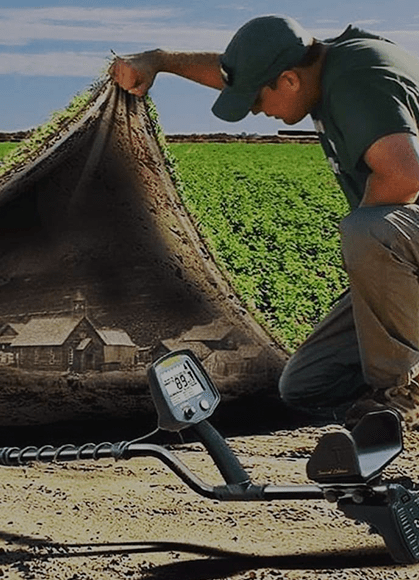
The vast majority of detecting finds across the UK come from the plough soil, which tends
to be between 8 and 10 inches in depth, whereas the average depth that metal detectors
will locate a small metallic item is between 4 and 6 inches. Therefore, the vast majority of
metal detecting does not conflict with archaeology because detecting finds come from the
plough soil that archaeologists generally ignore.
It is true, however, that many metal detectorists have helped to discover important
archaeological sites across the country that would never have otherwise been found. This
is from discovering ‘hot spots’ in areas with no previous archaeological record.
The majority of metal detectorists are in the hobby because they have a love of history and
value the opportunity to find and record historic items for future generations.
Unfortunately, modern farming methods from the Victorian period onwards are slowly
damaging and even destroying artefacts in the plough soil, and huge swathes of land are
being built on across the country, so the items being retrieved by detectorists are being
saved for posterity.
It would seem that between us, detectorists and archaeologists are the perfect partnership
to ensure that our historic artefacts are saved for future generations, but despite the best
efforts of the NCMD and detectorists to work together with archaeologists, a huge gap still
exists.
FINDS RECORDING…
The majority of finds come from plough soil and many detectorists record their finds via the
Portable Antiquities Scheme (PAS) database, but the availability of Finds Liaison Officers
is limited because the majority work part time in the role. Were they more accessible,
many more finds would be recorded than the 1.7 million finds that are currently on the
database.
Archaeologists on the other hand, don’t record their finds on the PAS database, nor on any
other similar database therefore their finds are not accessible to the public. They simply
file a report that sits on file in their local museum archive along with the artefacts they
recover.
They also find far fewer coins or artefacts because they don’t investigate the plough soil
surrounding their excavation sites.
22/05/2024
Page 2 of 10
TREASURE ITEMS
There are many hundreds of treasure items recorded each year by detectorists, many of
these are claimed by museums across the country and include items of National and
International importance. The majority of these items come from plough soil or from areas
that would never be investigated by archaeologists.
Archaeologists do find treasure items, but far fewer as they search a much smaller area in
their trenches during their excavations.
The treasure process has long been shrouded in mystery, as there was no transparency in
the process. Finds can take many, many years to go through the system with no updated
explanation or feedback whatsoever, and therefore many myths and theories on social
media have been created as a result.
The NCMD has tried to dispel the myths and provide some transparency by asking for
answers to the questions that are most frequently asked by detectorists. The PAS
suggested that they would create a Q&A list for us to share with our members.
Unfortunately, they then decided to cut us out and have it published in The Searcher
magazine, rather than provide us with a copy to share with our 38,000 members. I don’t
believe it was even offered to the Treasure Hunting magazine which seems rather one
sided? Why would you only want to share important information with a very small section
of those it affects?
THE NATIONAL COUNCIL FOR METAL DETECTING (NCMD)
The NCMD was formed over 40 years ago by a group of Metal Detectorists who came
together to fight the STOP campaign, which was a move by archaeologists to ban metal
detecting in the UK.
Had they succeeded, millions of finds would be still underground, the Crosby Garrett
Helmet, Ryedale Hoard, Hoxne Hoard and the Frome Hoard to name but a few. Also, the
PAS database wouldn’t exist, so this world class academic resource would also not be
available.
Interestingly, one of the most vocal of those fighting to ban detecting is now the Chair of
the PAS Advisory Group and is, I believe, a member of the APPAG Group that is carrying
out the inquiry into detecting? Is this not another conflict of interest?
Since this current NCMD committee was formed in 2021, we have worked tirelessly to
improve relations with the PAS and others, we have also invested heavily in technology to
support our members and to promote responsible detecting in the UK.
- We provide a wide range of information for detectorists, including training videos to
promote responsible detecting and best practise in the UK. - We have provided a range of country specific information, video’s, and search
agreements. We are currently producing additional videos to include recent
changes in the law, and to explain and demystify the treasure process.
22/05/2024
Page 3 of 10 - We have developed an extremely successful mobile app for accurately recording
finds and findspots. - We are currently developing a finds reporting portal that will allow for the recording
of current finds but also to record previous finds to allow members to create a full
digital record of their finds collection. - We will be producing a training video to highlight best practise for ensuring that
wherever possible, weights and dimensions are included in the record, and we will
be including tips on how to get the best photo’s using mobile phones. - This information will be available for FLO’s to access, and we have made the PAS
fully aware of what we are creating. We have offered to include the PAS and their
technical team in that development so that our technology can potentially integrate
into their new website, but we’ve been given nothing but negatives and reasons
why this isn’t a good idea, and nothing constructive to help make it work. - We have created a ‘Hoard Fund’ to contribute towards the cost of correctly
excavating hoards or significant finds, for a speedy recovery. We also provide a
‘hotline’ number for our members to call when they find something significant, and
we connect them with the relevant FLO as well as notifying the PAS.
Sadly, this doesn’t seem to be promoted by the PAS to their FLO’s, which seems
bizarre given the importance placed on items being retrieved by archaeologists so
that all contextual information can be recorded. Why is this? - The NCMD are currently working with Rally and Detecting Event organisers to
create a ‘Code of Conduct for Detecting Events’, so that we can ensure that ‘Best
Practise’ is being carried out by correctly managing the event and encouraging the
recording of finds.
The main focus of the PAS now seems to be on self-recording, which after 27 years
stands at 70 detectorists out of potentially 50 /60,000 detectorists, which can hardly
be classed as a success.
Conversely, archaeologists have never needed to record their finds on the National
database and so add to the academic resource for fellow archaeologists, which means
that members of the public never get to see them either. Instead, they end up in a written
file which gathers dust in some museum rather than being recorded on a national
database for the benefit of everyone. Why is this?
PAS NATIONAL CONFERENCE
The PAS National Conference in 2023 was held in York Museum and the theme was the
benefits of archaeologists working with detectorists. The NCMD wasn’t formally invited, but
we were made aware of it at a late stage by one of our Trustees whose wife is an
archaeologist.
22/05/2024
Page 4 of 10
A delegation of 5 NCMD committee members attended the conference, we met the Head
of the PAS and others when we arrived. During the opening speech, there was a formal
welcome for the teams of delegates from the DCMS, Natural England, NFU, English
Heritage and the National Trust, but there was no mention of the delegation from the
NCMD, there was no welcome and no acknowledgement at all which was very pointed,
especially given that the day was about working with detectorists.
Given that the NCMD represents some 75% of the detecting community, this is extremely
disrespectful and is indicative of their attitude towards us.
There were some good presentations, but none were from detectorists and indeed, there
was not one speaker from the detecting community, nor was the NCMD invited to speak.
A member of the DCMS who was present at the conference, expressed their surprise that
there were no detectorists involved in a conference whose theme was working with
detectorists!
Following the conference, I asked the organisers if the NCMD could have copies of the
presentations to share with our 38,000 members, but this was not forthcoming.
ISSUES FOR DISCUSSION
- Detectorists complain constantly at the lack of communication from members of the
PAS, both when recording finds and especially when going through the treasure
process. What can be done to improve this? - The general feedback from the PAS and from certain FLO’s is that we have a duty
to record finds, we have a duty to comply with the law, therefore we have no right to
complain about the process.
Interestingly, archaeologists don’t record their finds on the national database yet
don’t seem to have that same duty, except for potential Treasure. Why is this? - The criterion for recording finds with the PAS has been changed, but without any
discussion or debate. The PAS management are now insisting on an 8 figure grid
reference, otherwise they will refuse to record finds. Given that this is a voluntary
scheme, and this was never previously a condition, who agreed and sanctioned this
change? - The PAS insist that the majority of finds on the database are accurate to an 8 figure
grid reference, yet they also know that this isn’t the case at all because 90 % of all
the 1.7 million finds recorded were complete guesstimates.
a. For the first 20 years of the scheme, findspots were generally created by
finders pointing to a rough area of an OS map where the artefact was found,
and the grid reference was created by the FLO from that approximate area.
b. It may be 8 figures, but is based on the rough area the item was found, not
the exact findspot. Why isn’t this being acknowledged?
22/05/2024
Page 5 of 10
c. Archaeologists are fully aware that the spot that an artefact has been located
today bears no resemblance to where it was originally dropped or deposited,
because it has been moved around by the action of ploughing as well as the
effects of weather. Again, why isn’t this being acknowledged and why are
they now insisting on an 8-figure grid reference? Is this just to reduce the
number of general finds shown to them? - At a recent Pas Advisory Group meeting, it was stated that they wanted to contact
landowners and when asked why, stated that they were aware that many
landowners didn’t want detectorists to record to 8 figures, therefore the PAS wanted
to ask them to not allow detecting on their land at all, so that artefacts can be saved
for future generations.
This is despite knowing that finds are constantly deteriorating because of farming
methods and are also being buried under construction projects all across the
country. This therefore feels like a back door attempt to reduce and control metal
detecting with no real justification. Who sanctioned this? - At a recent PAS Advisory Group meeting, the NCMD raised the question of the
Archi subscription service, where subscribers have access to a huge database of
the UK findspots of metal detecting finds that are also on the PAS database. After
much debate, it was acknowledged that the PAS database is being ‘scraped’ of its
data, but there is nothing that can be done to stop this. Why is the PAS data not
being better protected? Why is it being allowed to help populate a subscription
service? - The NCMD Communications Officer sent an FOI request to the British Museum to
ask about items from detectorists that may have been lost, damaged or stolen when
going through the finds recording or treasure processes. He was advised that they
don’t have that information, so he should instead write to each individual museum
and each individual FLO for that information.
a. How can it be that the body overseeing the PAS processes has no idea of
what is going on within the PAS organisation.
b. How can the BM or the PAS not know if items they are ultimately responsible
for are being lost, damaged or stolen? - During a meeting of the PAS Advisory Group, we raised this subject and were told
categorically that it is not possible for finds to be lost, damaged or stolen because
all museums us the “SPECTRUM’ process for the secure storage and management
of finds.
This statement was not questioned by the Chair of the meeting, yet we know from
our own experience that this is certainly not the case for every location that handles
detecting finds, so what are the other processes being used? What are the
safeguards?
22/05/2024
Page 6 of 10 - When it became clear that a large number of potential treasure items were missing
in Cumbria, we were kept in the dark about it. When we later asked about it in an
Advisory Group meeting, we were told that due to a recent office move and a new
FLO taking over, a number of items had been mislaid and were no doubt in a box at
the back of a cupboard. It later transpired that there was no office move, no change
of FLO and it was already known that they had been stolen by a PAS officer.
It transpired that all the detectorists who had items stolen by the FLO were NCMD
members, so we were asking for information on their behalf but were given none.
We arranged a zoom meeting with the victims of the thefts to give them a voice,
collect the facts and try to reassure them that justice would be served. We invited
the head of the PAS to attend the meeting, but sadly felt that he had to decline our
offer.
When the theft of artifacts was discovered at the British museum, it made front page
news, and a statement was issued by the Chair of Trustees to reassure the public
that those responsible would be brought to justice and that all steps would be taken
to ensure that it can never happen again.
Yet when the theft of detecting finds was made by a FLO, there was no such
statement, no reassurance to detectorists that their finds would be safe in future.
Why was that? Do detectorists not matter? Are we not also tax-paying members of
the public?
What we actually received from the PAS was a statement that “As these were
potential treasure items, they don’t actually belong to the finder, they belong to the
state, so we don’t understand why you are complaining”. Well not all the stolen
items were potential treasure, but even if they were, surely that would still have
been a crime. Is that acceptable?
Why did the Trustees of the BM not get involved with the PAS stolen items? Having
45 odd FLOs working for PAS, but all having a different boss must be a recipe for
disaster, but ultimately, the BM is responsible.
After pushing for an update, the NCMD was told in early January that all the
information had been collated and that a decision on potential charges would be
made at the end of the month or certainly by early February. It is now May and still
no news. What has now changed?
This has fuelled rumours of a cover up and certainly undermines the confidence of
detectorists in the PAS processes as it stands now.
Can we reassure our members and the landowners that all the finds that they hand
in will be kept secure, because new measures have been put in place by PAS to
ensure their safety?
What is being done to restore the confidence of detectorists and the general public?
22/05/2024
Page 7 of 10 - Our question and answers are regularly being excluded from the PAAG meeting
minutes. These excluded items are presumably being sanctioned by the Chair of
the meetings.
a. For instance, when questioned why both the question and the answer given
about items stolen while in the care of the PAS were deliberately excluded
from the minutes, they blamed the delegates for not checking.
No answer or apology ever given. Similarly, the topic of exact findspots was
completely omitted and we had to push for their inclusion. Does the Chair
and minute taker of a DCMS meeting have the right to exclude and change
what they disagree with?
b. It will be interesting to see if the discussions around the scraping of the PAS
Database is included in the next minutes, or the PAS asking farmers not to
allow metal detecting so that finds can be left in the ground for future
generations.
c. This treatment generates a feeling that we are not seen as an equal partner
in the process, especially when we discover that the Chair of the PAAG is
involved in other groups and is apparently holding secret meetings with
others about the future of metal detecting. - Are the ministers and the DCMS aware of the Institute of Detectorists and the
£50,000 public funds that were allocated to this project? Are they aware of how the
money has been spent, who has benefitted? and whether it represented value for
money?
The funding was supposed to be for the setting up of an organisation to provide
training to those detectorists that would like to assist in archaeological excavations,
by learning the correct techniques for working in and around trenches. It seems that
after much public money and 7 years, this project has gone nowhere, so why is
that? and is it being done again?
QUESTIONS ABOUT THE INQUIRY.
- Why are the APPAG meetings being held behind closed doors? Why are there no
agendas or meeting minutes being published? Where are the minutes of the
previous meetings? - Are the members of these secret groups deciding what information the Ministers get
to see as part of this inquiry?
How can a Minister form a fair and considered judgment if he is only told one side of
the story?
Where is the democracy or fairness in that process? - Why wasn’t the NCMD involved in any of the discussions leading up to the Inquiry?
22/05/2024
Page 8 of 10 - Why isn’t the NCMD being represented in the Inquiry itself, given that we represent
around 75% of the detecting community? - Why does the APPAG have discussions with members of the PAS but not members
of the detecting community or the largest official body that represents it? - Would the Inquiry looks into the possibility of bringing in legislation to make it
compulsory for future construction projects, to require a metal detecting survey to
be carried out across all the land that is being built on, so that some of the artefacts
and coins contained in the plough soil can be saved from being lost forever?
How many thousands of important artifacts would this help to save for the nation?
How many Crosby Garret Helmets, Ryedale Hoards or Frome hoards would this
help to save for the benefit of future generations?
I was recently informed that a large hoard had been discovered on a building site by a
digger driver. He had no idea of the law and his company had no protocols in place for
such an event, or if they did, he was unaware of it.
He ended up dishing the contents of the hoard out to his mates at his local pub, but
fortunately the local FLO was made aware and at least some of the items had been
recovered.
I have numerous examples of similar events, of items being scattered across construction
sites and lost to the nation forever. These items would all have been saved and recorded
had a metal detecting survey taken place before construction began. Doing it as part of the
planning process would make sense, would cause no delays, and would incur no
additional cost.
Local detecting clubs would provide the service for free but would be required to record
their finds using the NCMD portal and would be allowed to keep what they find unless
deemed to be treasure. All potential treasure items would go through the normal process
and be divided equally between the finder and landowner as at present.
CONCLUSION
It is unfortunate that after more than two years of trying to work more closely with PAS and
PAAG we feel we are still being kept at arm’s length.
We have been constantly striving to provide solutions to help solve current problems to the
benefit of all parties, yet our efforts are being ignored. It genuinely feels that the PAS don’t
actually want to find solutions, therefore our only conclusion can be is that they are
working to a different agenda.
The fact that this inquiry is so one-sided, and yet again we are being excluded from the
debate means we therefore have no choice but to push back.
Hopefully, this report will go some way to providing the detectorists side of the story
because unless it is recognised and agreed that there is a problem, there can be no
solution.
22/05/2024
Page 9 of 10
Ultimately, the preservation of our history is at stake here, there is still a huge number of
artefacts in the ground, left to us by our forebears. Whether it remains there to be
destroyed and lost forever or is recovered and recorded for posterity is what this debate is
really about.
The NCMD and the detecting community we represent are very clear that we have a duty
to ensure the retrieval and preservation of our nations heritage. In order to achieve this, we
are happy to work with any and all agencies to create a cohesive solution that benefits all
parties.
In my very first meeting with Michael Lewis, Head of the PAS I stated that I could never
understand why there is such a gulf between archaeologists and detectorists, because we
both share a love of history, we are both passionate about the preservation of our history
and it’s therefore in our mutual interest to be working together to achieve this because
both sides have a part to play.
I believed that statement to be true then, and after almost three years in my role, I believe
it more than ever and will continue to strive for an effective solution to this issue.
Alan Tamblyn
NCMD General Secretary
Email: generalsecretary@ncmd.co.uk
Mobile: 07967 823064
For and on behalf of;
The NCMD Policy Committee
The NCMD Board of Trustees
The NCMD Membership of 38,000 members
The Metal Detecting Community and everyone involved in the hobby.
Addendum – In our discussions with Michael Lewis, we have mutually agreed the
importance of working closer together and to this end, we recently met for an informal
meeting on Monday 20th May 2024, to discuss how we can best achieve this. It was an
extremely positive and productive meeting that will hopefully form the basis of a way
forward.
That said, there is a much bigger debate that needs to be held if we are to protect and
preserve our national heritage for future generations.
22/05/2024


 udigidig.com